Concrete Washout Pan vs. Lined Pit: Which Washout Container Is Right?
A washout pan or container is usually the better choice: it needs no digging, can’t leak into the soil and leaves on a truck. A pit only makes sense on big open sites with plenty of room and a crew to maintain it.
Washout pan vs. lined washout pit
| Lined washout pit | Watertight washout pan or container | |
|---|---|---|
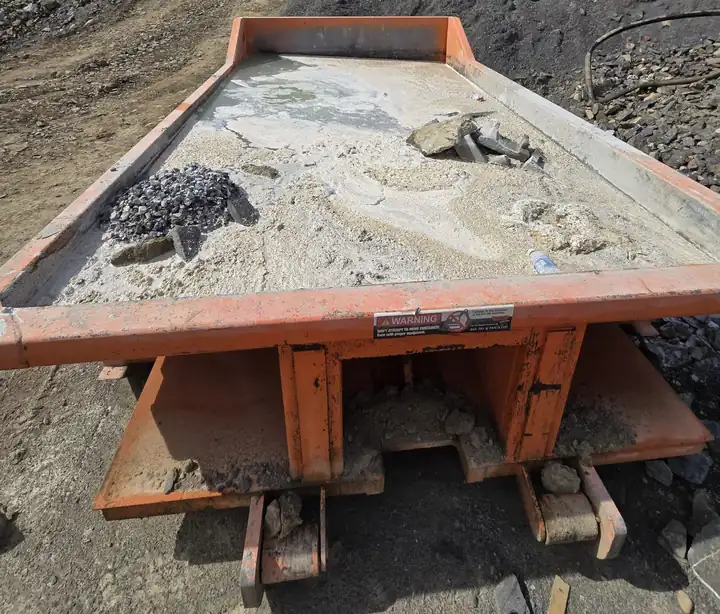
| Setup | Dug and built on site by your crew | Delivered and set in place |
| Room on site | A big piece of the lot for the whole job | From a 1.5 yard pan that slides under a pump hopper |
| Leaks | Can leak into the soil | Watertight steel |
| Upkeep | Your crew watches it | Call when it’s getting full |
| Cleaning out | Your crew digs out the hardened concrete | We pick it up full and handle the disposal |
| Moving it | Can’t | Call us and we move it |
| End of job | Dig out, dispose, backfill, regrade | Final pick-up |
What a pit really costs
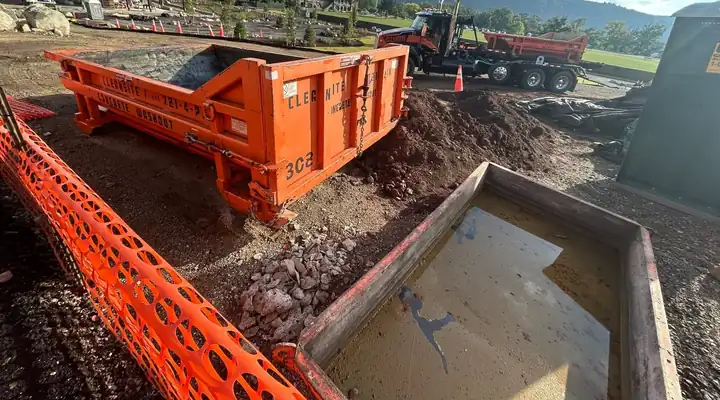
Nobody sends a bill for a pit, so it feels free. The costs show up in excavator time, materials, a crew to build it and keep an eye on it, and the dig-out at the end.
Burying the washout afterward is the part that goes wrong: buried washout can leave a dead patch in a yard, and New York’s standard says wash water must never infiltrate the soil.
What a concrete washout system has to hold
Washing out concrete trucks leaves three things behind: wash water from the chutes and hoppers, cement slurry, and leftover concrete that hardens in the bottom. Any concrete washout system, pit or prefabricated container, has to contain the concrete waste and the wastewater until it leaves the site, and keep the washout water out of storm drains while the concrete work goes on.
The difference is what happens after. With a pit, your crew waits until the solids have hardened and digs them out. With a CleanSite container, the water, slurry and concrete leave together: when the container is full, you call us, and we pick it up and handle the disposal.
How each containment system handles water and solids
Every washout collects two things: wash water and hardened solids. In a pit, the water is vacuumed off or allowed to evaporate and the solids are dug out later. In a prefabricated washout container, water and solids leave together when the container is picked up.
The water is the risky part. The EPA describes concrete wash water as caustic, with a pH near 12. A pit that leaks lets it reach the soil or storm drain inlets. A watertight bin or container keeps it contained, which is why stormwater management is simpler with a container, whether the washout comes from a mixer chute, a pump hopper or stucco crews.
The EPA’s construction permit accepts either a leak-proof container or a leak-proof pit, so both can meet the rules if they’re looked after. The container is the one that does it without the upkeep.
How much room each one takes
A pit takes a fixed piece of the site for the whole job, and it can’t follow the work. A washout pan or container sits on a small footprint wherever a truck can reach it, the 1.5 yard pan slides under a pump hopper, and when the work moves, you call us and we move it.
On tight lots, driveways and city sites that usually settles it: there’s no room to dig, but there’s room for a pan.
When a pit still makes sense
A pit can work on a big, open rural site with lots of room, a long schedule, and a crew with an excavator already there. For almost everything else, a washout container service is simpler.
Pan vs. pit FAQ
Do washout pits work?
They can, but a pit has to be built right, looked after for the whole job and dug out at the end, and if it leaks, washout gets into the soil. A container skips all of that.
Should washout pits be covered?
Covering one before rain helps prevent overflow. A container that gets picked up before it’s full avoids the problem.
Is a washout pan allowed instead of a pit?
Yes. The EPA’s construction permit allows a leak-proof container or a leak-proof pit.
Related pages
Request a concrete washout container
Tell us the jobsite, the pour date, the expected yardage and whether you have ready-mix trucks, a pump or both. We will match the size and set up delivery.
Send us your job details
We’ll call you back with a container size and delivery time. In a hurry? Call 845-781-4-PAN.